Showing posts with label training philosophy. Show all posts

Tuesday, April 2, 2013

And So It Begins…

 
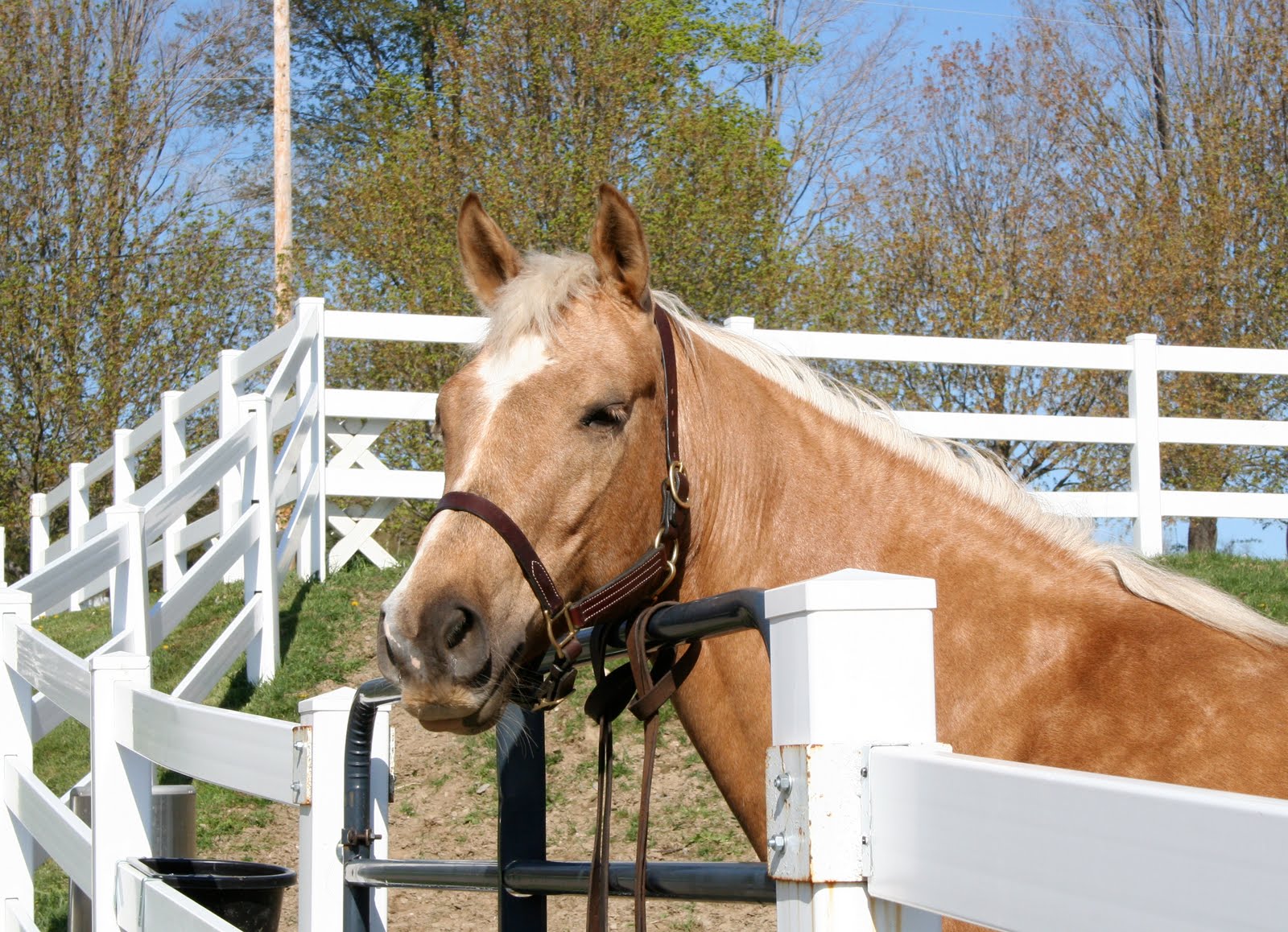
Mr. Blue
"Sorry no work today can't you see I'm trying to take a nap!"


Spring is officially in the air and it’s time I started riding consistently again.  This past weekend I decided that Blue and Dusty should start getting back in shape after being virtually on vacation for the winter.  
  
Blue, who hasn’t been ridden all winter and has been an eating machine at the hay nets, is very out of shape and dare I say a little on the pudgy side. Much to his dismay that’s all about to change.  As soon as the grass comes up, Mr. Blue will be sporting a grazing muzzle.
As for riding, Blue’s definitely not a push-button pony. He knows his aids well enough.  Whether he chooses to listen is another thing entirely.  Blue is never dangerous or malicious, but he can be lazy.  And if you let him get bored he will use that excuse to amuse himself at your expense.  He also has an extensive bag of tricks in his arsenal.
As for riding this weekend, we’ve starting back slow because he is overweight and out of shape.  I didn’t want to put him on the longe because circles might be too hard on his joints right now.  Instead, we walked, working on basic steering and bending.  Blue has a tendency to become stiff and tense when the aids are applied (they mean work!) so we've decided to start from the very beginning and working on just getting him to relax and stretch rather than ball up and get ready to resist the non-work we were planning to do. 
When we first started out Blue began by counter-bending and popping his shoulder to the inside. This is his way of letting you know before you even begin that he doesn't feel like doing all of that bending and collecting hard work you probably have in mind. Little did he know I had no intention of doing any of that stuff. My plan was to beat him at his own game. He’s a very strong horse and there is no sense fighting with him. Instead, all I worked on was getting a soft, gentle bend in his neck to the inside with an opening/leading rein. I didn’t care where he went as long as he kept the bend. To avoid the temptation of neck-reining or leading him out to the rail with my outside rein, I just dropped it completely. I actually put my hand on my outside knee so I wouldn’t inadvertently use it.  There was no seat direction from me--only a relaxed following seat; no leg cues either. Just the pressure and release of the opening inside rein to guide him.
  
He corkscrewed a few times but I just led him across the arena, changed direction, etc., and eventually he caught on. He softened his entire body, stretched his head and neck down and sighed. We made a few impressive 20-meter circles with just the inside rein to steer by in either direction and ended with that for the day. I was surprised by how much riding I was able to finesse out of him with just the pressure and release of a single inside opening rein--no neck rein, no indirect rein, no special leg aids other than riding him forward, etc. By the end he was soft, relaxed through his topline, stretching down long and low, tracking up with no resistance anywhere. It was a totally new Blue.  It was surprisingly EASY!
As I said Blue knows his basic cues and if he’s being difficult I know I can make him do what I want. This year, however, I want to try a different type of riding with him.  I would rather he be light and willing, enjoy his job and look forward to our rides.  So we’re starting with the basics as if he’s a green horse and sort of re-training him to a different mindset.  It will take time and patience and I’m hoping he will enjoy his riding time more than he has in the past.  Not that he’s ever done any heavy lifting. I haven’t ridden him much at all through the years so it will be a learning experience for both of us. Who knows, he might even look forward to seeing me when I show up to ride in the future.

Until next time

Quote for Today
A horse is an animal not a machine and is only as good as it's rider.

Thursday, January 31, 2013

Not Quite A Book Review


" Grady "


During my down time from riding I’ve been reading some horse related books.  Recently, I finished a book that I thought might help with Donnie’s problems.  It’s called  “Empowered Horses” by Imke Spilker.  The description of the book states, “Learning Their Way through Independence, Self-Confidence, and Creative Play.”

The basic idea behind this book is to discover your horse’s independence in a “human's world” by becoming more passive, receptive, and accepting, giving your horse the physical and emotional space to take an unbelievably active role in your interaction in both work and play. To support the horse with exercises and develop games that will collect and balance his body as if by magic.  How with these interactions the horse will enthusiastically work with you inviting you along for the ride of your life. (This is basically copied from the back cover of the book)

I found there were some good insights to be found in this book.  One being that horses never get to choose what they want to do but are constantly told what they must to do. They are never given the free choice to refuse. Also, if we want willing partners, we have to empower them by giving them the choice to work with us.  There is some little bit of agreement on my part with this basic statement.  However, as I read more and more I couldn’t see myself going along with all the games played with the horses in the book.  One segment has the girl and a horse running up and down hills playing together with a collar attached around his neck and a lead.  Other games included running around the arena with the horse being free.  That’s just not in the cards for me, although it seemed to work for them. The book makes it clear that you can devise your own games of play to make it fun for the horse.  It’s all about thinking of ways to be receptive to your horse.

Some other things also struck me as not-so-doable.  Sure, I'd love to empower Dusty with all kinds of free choice, but she's already an opinionated mare, and I'm well aware of how she feels about most things.  If I followed this book's advice, walked into the field to put Dusty’s halter on and she turned away then she’s telling me no she doesn’t want to come and work or play with me.  If I subscribed to this theory, she’d never have to do anything she didn’t want to.  The principle behind all the playing and games is to empower the horse and make the horse want to be with you and interact with you all the time.  If you ask for something and they say no, then it’s their choice and you should respect it.  

I may have interpreted the book wrong, but as I read it I was picturing all of our horses and their distinct personalities, most of the time thinking what would work for some and not for others.  I came to the conclusion that Dusty would more than likely take advantage of the situation and tell me to take my halter and take a hike if given the choice--but maybe I'm not giving her enough credit?  The boys might be more receptive to some of the concepts and games, but not all.  A lot of times when they come up to me in the field or follow after me in the arena it's because they think I have treats in my pockets.  I believe the horses they worked with in the book were much younger than my herd and probably more open to suggestions.  My herd has mostly been there, done that and know when they can take advantage of a situation.

There were movements on teaching the horse to balance and be aware of their bodies.  It would take too long to go into it all here and the pictures do better justice to the techniques than I could write down.  A picture is worth a thousand words. Most were done from the ground but it also covered how they would introduce them to a saddle and rider.  Some of the time the riders in the book would jump on bareback with no bridle and walk and trot around the ring.  Again, that’s not in the cards for me right now--or probably ever. 

So in conclusion my thoughts on being with and training horses would basically come down to the theory that there is a balance to be had between not domineering, manhandling and downright abusing a horse and still getting respect from them and attaining training goals.  If everything is left up to the whim of the horse, it can be a recipe for disaster or just a plain waste of time.  The book’s basic principle is good if not taken to extremes.   And if taken the wrong way her ideas could be dangerous.  In my inexpert opinion, it’s not a complete training philosophy, but a good idea to keep in the back of your mind when dealing with your horses: they're involuntary partners who didn't sign up for this, so try to be patient, give them as much choice as possible within reason (i.e., listen to them when there is resistance to see if there is a LEGITIMATE cause) and make it fun.  But it shouldn't be a free-for-all either, so don't mistake this for a true training philosophy or a way of life.   Be mindful if this is all you do all day your horse will be out of control and you might get yourself killed.  Not to mention you will basically have a big pet on your hands.  It’s nice if we all have warm fuzzy feelings about our horses, but if that's what we want, maybe we should have house cats and not 1000lb+ animals.

Partnerships with horses demand MUTUAL trust, but also respect. Training, by nature, requires one party to do the asking and the other to do the answering.  To be clear, it's the human who is training the horse, not vice versa.   Asking correctly is what being a good horseman is about.   The horse shouldn’t be allowed to give you the finger and walk away any time he chooses.  That to me isn't empowering horses, that's disempowering humans.  For the short time he's asked to do his job, in exchange for his room and board, it's not too much to expect that they meet us half way.  Many horses may have been demeaned by humans in the past and will continue to be demeaned by humans in the future, but it doesn't mean we have to demean ourselves to be better horsemen.  We can still be good horsemen without making ourselves ridiculous in the process.  Prancing around fields Julie Andrews-style (cue the “Sound of Music”) with our horses and calling it "training" isn't empowering to either species--it's embarrassing.

While this isn’t a book review if you are at all interested in something covering these principles of training and interacting with your horse you might be interested in checking it out.  The book has wonderful pictures showing how it helped the horses they worked with and their methods.  The author and assistants worked long and hard on this book for years.  I’m sure I’m over-simplifying what the book actually wants the readers to grasp to better understand their horses.  When I started this post I felt like I was back in high school writing a book report.  You know when you really have to condense a whole book into a few thoughts.  What are you’re thoughts on this sort of training for horses?

Until next time

Quote for Today

Closeness, friendship, affection: keeping your own horse means all these things.
    - Bertrand Leclair

Thursday, September 29, 2011

Poor Mistreated Blue


" That's not a saddle, is it ?"

Have you ever had a horse that really despises being ridden and gives the impression he believes he is being forced against his will to do exhausting work for an excruciating period of time--even if he's only being worked lightly for an hour or so a few times a week?  Well, I do, and his name is Blue.  The worst part of this scenario is that I actually feel guilty about riding him because I know he doesn’t want me to.  He makes his feelings known by making me hike out to get him while he plays the “I can’t see or hear you game,” all the while munching away.   My other favorite is his sighing when I put the saddle on his back.  Blue can be very dramatic if I do say so myself. 

Just the other day I put Blue in the side paddock so he wouldn’t high-tail it to the back pastures.  By the time I got done with some chores, I decided not to ride because it was so hot and humid.  In other words, the governor called and he got a reprieve.  When I released him through the gate to his usual pastures, he took off at a gallop and didn’t stop until he was waaaay out back.  That certainly tells me something.  Whoopee, no riding today and I am so outta here!

The question is how do you get a horse to enjoy his job?  Personally, I think it’s just Blue’s personality.  He’s very smart, very lazy and a horse unto himself.  He seems to need no one, not even the herd.  Blue is a horse that is very comfortable with himself whether completely alone, standing in the middle of a deer herd or on the top of the manure pile in the dumpster (which I’ve seen him do.)  He seems to be oblivious to the world around him until a gate is left open, then he’ll make a beeline and be out of the gate in a flash.  So he does know what’s going on, he just doesn’t seem to care.

I’ve come up with a plan to try and interest him in working and, more importantly, enjoying himself.  From now on after our walking warm-up we’ll start right out with trotting some cavelletti because that seems to perk him up.  His ears come to attention and his pace picks up (Blue only enjoys jumping, but I’m not ready for that just yet.)  Then we’ll dispense with the trotting and canter a bit then maybe move on to some more trotting.  Of course, there can’t be two days in a row of this, so on every other day he needs to go out on a trail ride with some hacking in the field thrown in for good measure.

In my opinion it is very important to keep a horse’s work interesting.  The more Blue finds something that will challenge his mind and talent, the more he will enjoy his time with me.  If I set him up to succeed even with the smallest challenges and offer lots of praise, hopefully he’ll start to look forward to seeing me coming towards him with saddle and bridle.  Then again, we’re talking about Blue here and nothing I do may change his mind.  He was born with his own personality and set of rules to live by.

If anyone has had a horse like Blue I’d be interested to hear how you got him over his “I hate to work” attitude.

Until next time
Quote for Today
The horse thinks one thing and he who saddles him another.
  - Benjamin Franklin-

Wednesday, June 2, 2010

Dusty Rides Again


' Dusty Rides Again '

This past weekend, Dusty and I got a few rides in and I’m happy to report that we accomplished some good behavior.  I hadn’t been able to ride for two weeks because of other commitments so it was a treat for me.  For Dusty, in reality, she couldn’t care less.

Our first ride was in the outdoor ring and she did really well controlling her enthusiasm.  On her last few rides she’s been really tracking up well!  Color me surprised; with her conformation, I didn’t think she had it in her, physically.  I’m sure it’s due to all her wonderful training.

Next day we had quite a long and interesting ride.  We started out by walking around the outside of the indoor arena; there was lots of snorting going on, but if that’s the worst spook she’s got in her I’ll take it. As we rounded the arena heading to the front doors, she had to cross a round grate that’s part of the drainage system. She stopped, snorted, backed up and turned herself around a total of  4 times.  I didn’t push the issue and went up the hill a ways and around the drain, into the indoor.  After walking around on the stone dust and a few snorts about the plastic fabric base that’s still showing in places, we left.  Mind you, the bulldozer sitting in the middle didn’t bother her at all, just the scary plastic.

After our foray into the arena we headed to the back field.  I planned to mosey around for a while as the day was heating up quickly.  Unfortunately, Dusty had something else in mind. Mainly she wanted to turn around and go back to the barn.  As she turned around I softly led her into a circle to get her mind on the fact that we weren’t heading back just yet.  She accepted this with no problem. Then we worked in the outdoor arena for a short while and she seemed to have a fine time and ended up proud of herself for getting everything right.

I know there are a lot of riders and trainers who would disagree with my particular method of dealing with Dusty - or many of our horses, for that matter.  I’m sure there are some who are right now shaking their heads and saying to themselves that I should have forced her over that drain and not gone around it. Or instead of doing large quiet circles to get her mind on moving and away from her thoughts of turning home, perhaps I should have forced her to listen to me,  made her do my bidding and shown her that I was herd leader and all that comes with that sort of training.

Here’s my basic philosophy concerning most of my training techniques:  I find no reason to pick a fight with a horse that is genuinely afraid of something and refuses to comply. If there is a simpler, less dramatic way to get through a ride with the same result, why bother forcing the issue?  As we continue to practice each task, she will eventually accept it more willingly than if I did force her. As for her turning towards home, I think I got my point across that she could turn that way but when we came out of the circle we were heading in my preferred direction.  It seemed a better solution than if I were to have pulled her around and forced her, just to show her who’s the leader.

Being the leader... hmm.  Now that’s another question that sort of baffles me. Dusty knows she is the alpha mare in her small herd of mares.  I know who I am in the human herd I interact with.  It seems to me that Dusty has figured out by now that I’m not a horse, so she doesn’t have to “alpha” it over me, as it were.  I’m not her herd leader but her rider and teacher.  When I ride, I try to teach her the right way of doing things.  But I don’t expect her to learn all of it on the spot.  And I don’t demand that she blindly trust me when she’s afraid; trust has to be earned.  It’s a gradual process, and learning the right way will make it easier for her to relax and understand what I’m asking.  If what I ask is appropriate and fair at her stage of training, and takes into account the immediate circumstances, she’s more likely to respond willingly now and in the future.  That’s what makes the kind of rides we will both enjoy.

So the point I am getting at here is simply that, if we respect each other, neither one of us should force the other into doing something we don’t want to do.  We can have a civil conversation and arrive at the same conclusion without any shouting, kicking or pulling.  As we learn from each other how to relate, I’m sure in the end we will form a respectful, lasting partnership.  And really, isn’t that what it’s all about…?

Until next time

Quote for Today
At its finest, rider and horse are joined not by tack but by trust. Each is totally reliant upon the other..... Each is the selfless guardian of the others very well being.