|
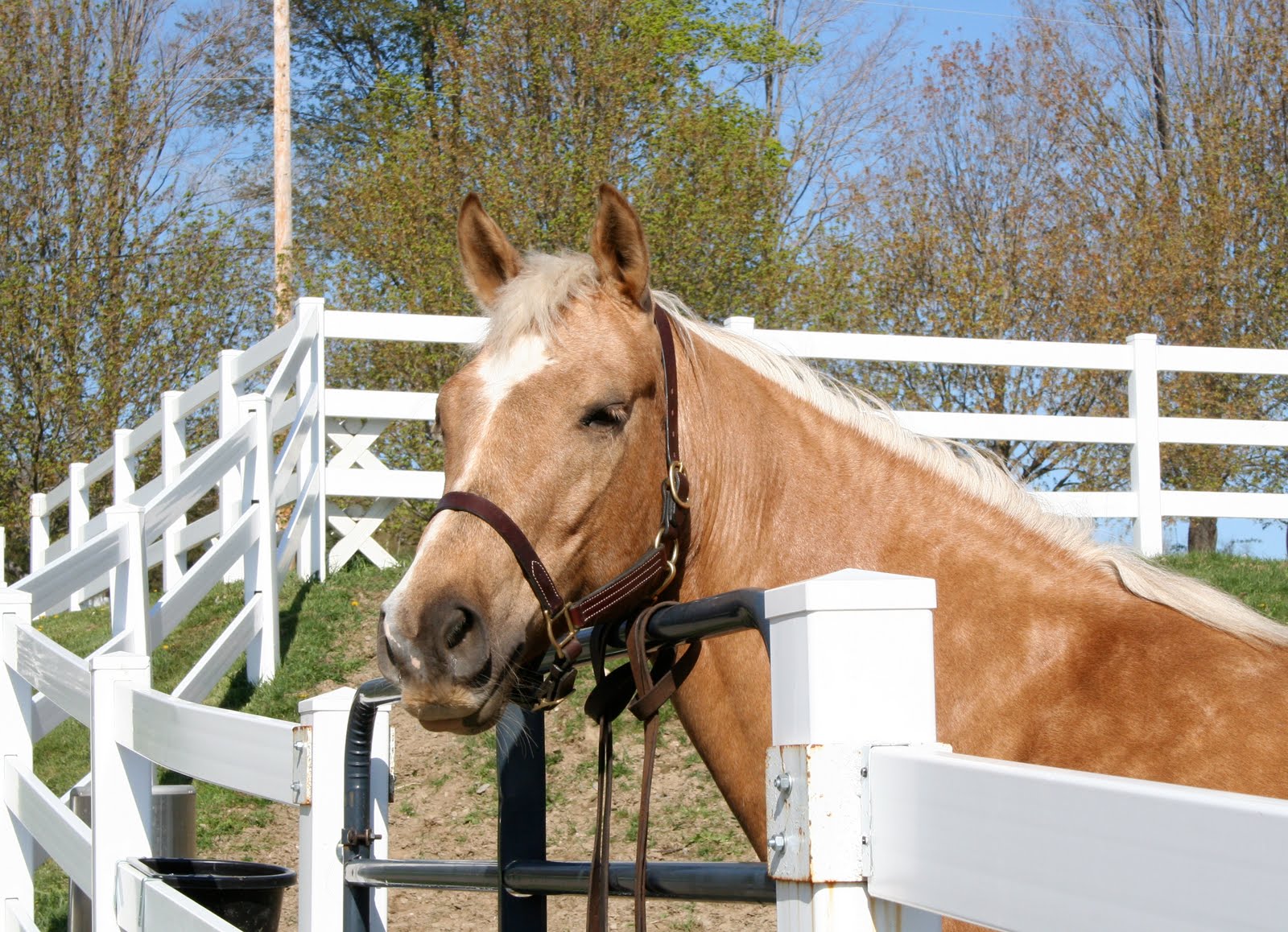
| " Grady " |
During my down time from riding I’ve been reading some horse related
books. Recently, I finished a book that I thought might help with
Donnie’s problems. It’s called “Empowered Horses” by Imke
Spilker. The description of the book states, “Learning Their Way
through Independence, Self-Confidence, and Creative Play.”
The basic idea behind this book is to discover your horse’s
independence in a “human's world” by becoming more passive, receptive, and
accepting, giving your horse the physical and emotional space to take an
unbelievably active role in your interaction in both work and play. To support
the horse with exercises and develop games that will collect and balance his
body as if by magic. How with these interactions the horse will
enthusiastically work with you inviting you along for the ride of your life.
(This is basically copied from the back cover of the book)
I found there were some good insights to be found in this
book. One being that horses never get to choose what they want to do
but are constantly told what they must to do. They are never given the free
choice to refuse. Also, if we want willing partners, we have to empower them by
giving them the choice to work with us. There is some little bit of agreement
on my part with this basic statement. However, as I read more and
more I couldn’t see myself going along with all the games played with the
horses in the book. One segment has the
girl and a horse running up and down hills playing together with a collar attached
around his neck and a lead. Other games included running around the
arena with the horse being free. That’s just not in the cards for me,
although it seemed to work for them. The book makes it clear that you can
devise your own games of play to make it fun for the horse. It’s all about thinking of ways to be
receptive to your horse.
Some other things also struck me as not-so-doable. Sure,
I'd love to empower Dusty with all kinds of free choice, but she's already an
opinionated mare, and I'm well aware of how she feels about most things.
If I followed this book's advice, walked into the field to put Dusty’s
halter on and she turned away then she’s telling me no she doesn’t want to come
and work or play with me. If I subscribed to this theory, she’d
never have to do anything she didn’t want to. The principle behind
all the playing and games is to empower the horse and make the horse want to be
with you and interact with you all the time. If you ask for
something and they say no, then it’s their choice and you should respect
it.
I may have interpreted the book wrong, but as I read it I was
picturing all of our horses and their distinct personalities, most of the time
thinking what would work for some and not for others. I came to the
conclusion that Dusty would more than likely take advantage of the situation
and tell me to take my halter and take a hike if given the choice--but maybe
I'm not giving her enough credit? The boys might be more receptive
to some of the concepts and games, but not all. A lot of times when
they come up to me in the field or follow after me in the arena
it's because they think I have treats in my pockets. I believe the horses
they worked with in the book were much younger than my herd and probably more
open to suggestions. My herd has mostly been there, done that and
know when they can take advantage of a situation.
There were movements on teaching the horse to balance and be aware of
their bodies. It would take too long to go into it all here and the
pictures do better justice to the techniques than I could write down. A picture is worth a thousand words. Most were
done from the ground but it also covered how they would introduce them to a
saddle and rider. Some of the time the riders in the book would jump
on bareback with no bridle and walk and trot around the ring. Again,
that’s not in the cards for me right now--or probably ever.
So in conclusion my thoughts on being with and
training horses would basically come down to the theory that there is a balance
to be had between not domineering, manhandling and downright abusing a horse
and still getting respect from them and attaining training goals. If
everything is left up to the whim of the horse, it can be a recipe for disaster
or just a plain waste of time. The book’s basic principle is good if not
taken to extremes. And if taken the wrong way her ideas could be
dangerous. In my inexpert opinion, it’s not a complete training
philosophy, but a good idea to keep in the back of your mind when dealing with
your horses: they're involuntary partners who didn't sign up for this, so try
to be patient, give them as much choice as possible within reason (i.e., listen
to them when there is resistance to see if there is a LEGITIMATE cause) and
make it fun. But it shouldn't be a free-for-all either, so don't mistake
this for a true training philosophy or a way of life. Be mindful if
this is all you do all day your horse will be out of control and you might get
yourself killed. Not to mention you will
basically have a big pet on your hands. It’s nice if we all have warm
fuzzy feelings about our horses, but if that's what we want, maybe we should
have house cats and not 1000lb+ animals.
Partnerships with horses demand MUTUAL trust, but
also respect. Training, by nature, requires one party to do the asking and the
other to do the answering. To be clear, it's the human who is training
the horse, not vice versa. Asking correctly is what being a good
horseman is about. The horse shouldn’t be allowed to give you the finger
and walk away any time he chooses. That to me isn't empowering horses,
that's disempowering humans. For the short time he's asked to do his job,
in exchange for his room and board, it's not too much to expect that they meet
us half way. Many horses may have been demeaned by humans in the past and
will continue to be demeaned by humans in the future, but it doesn't mean we
have to demean ourselves to be better horsemen. We can still be good
horsemen without making ourselves ridiculous in the process. Prancing
around fields Julie Andrews-style (cue the “Sound of Music”) with our horses
and calling it "training" isn't empowering to either species--it's
embarrassing.
While this isn’t a book review if you are at all interested in
something covering these principles of training and interacting with your horse
you might be interested in checking it out. The book has wonderful
pictures showing how it helped the horses they worked with and their methods. The
author and assistants worked long and hard on this book for years. I’m sure I’m over-simplifying what the book
actually wants the readers to grasp to better understand their
horses. When I started this post I felt like I was back in high
school writing a book report. You know when you really have to
condense a whole book into a few thoughts. What are you’re thoughts
on this sort of training for horses?
Until next time
Quote for Today
|
Closeness, friendship, affection: keeping your own horse means all
these things.
- Bertrand Leclair
|